How to Turn an AI Market Analysis into a Word Business Report with KPIs, Risks, and Action Items
An AI-generated market analysis can contain useful research and still produce a weak business report. The draft may begin with several pages of background, repeat the same finding, mix facts with recommendations, and bury the decision that managers need to review.
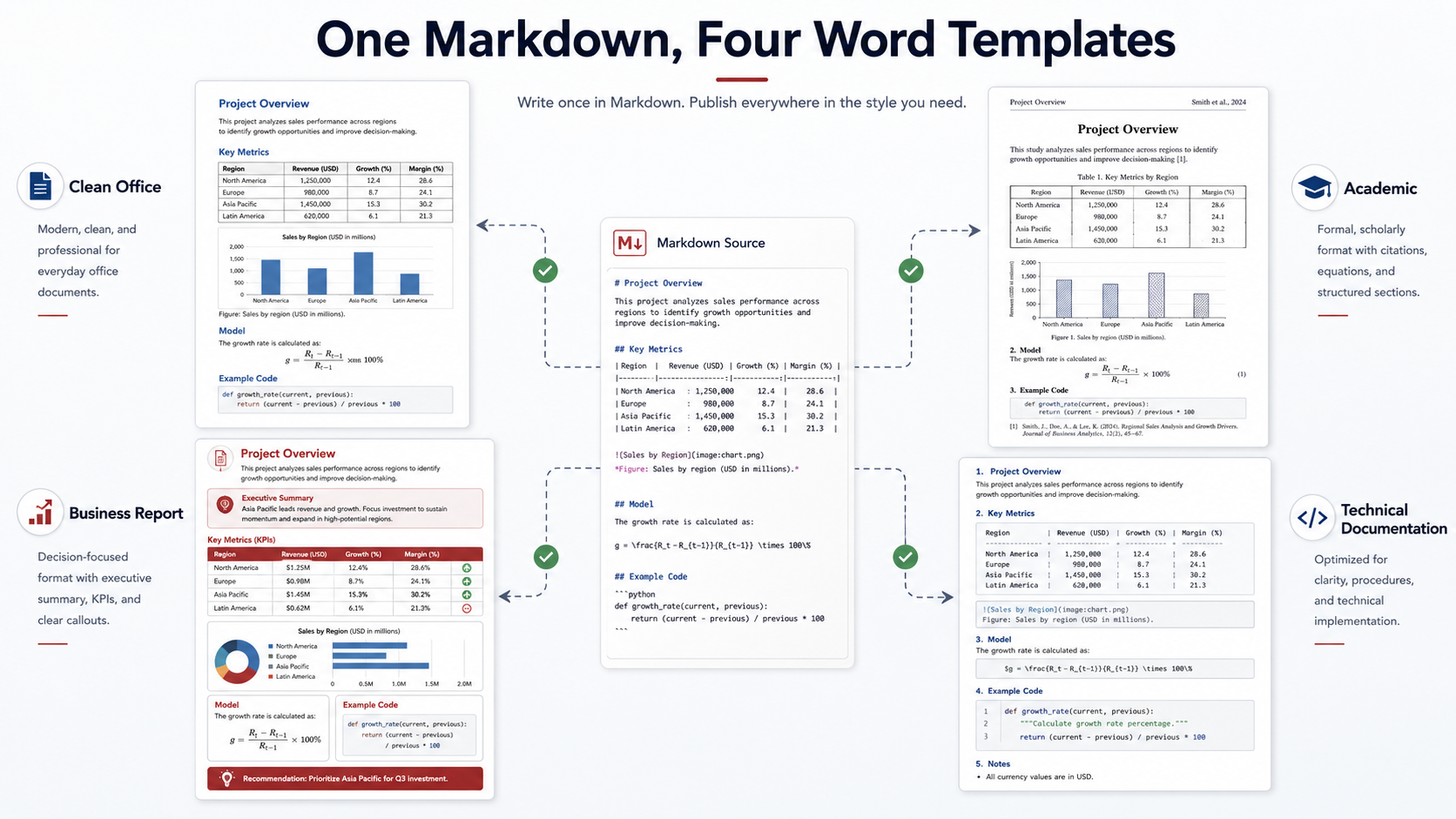
A business Word template can improve presentation, but it cannot decide which evidence belongs in the executive summary, which numbers deserve a KPI table, or which recommendations require an owner and deadline. Those decisions should be made in the Markdown structure before conversion.
 A business report should surface decisions and risks before supporting detail.
Why a good AI answer may still be a poor business report
AI tools commonly optimize for completeness. Business readers optimize for speed, accountability, and decision quality.
- A long introduction before the main finding
- Several sections repeating the same trend
- Recommendations mixed into factual analysis
- Metrics scattered across paragraphs
- Risks without likelihood, impact, or mitigation
- Actions without an owner or target date
Start with the decision
Before editing headings, write one sentence that states the report’s decision or review purpose.
Purpose: Decide whether to enter the mid-market document automation segment in Q4.
Every major section should help answer that decision. Useful material that does not affect it can move to an appendix.
Use a decision-first structure
# Market Entry Assessment

## Executive Summary
## Decision Required
## Market Evidence
### Demand
### Competitors
### Pricing
## Financial and Operational Impact
## Key Risks
## Recommended Actions
## Appendix
Write the executive summary last
Although it appears first, the executive summary should usually be written after the analysis. It needs to reflect the final finding, recommendation, and main risk.
- What did the analysis find?
- Why does it matter now?
- What decision is recommended?
- What is the main condition or risk?
This report examines the market, competitors, pricing, technology, customer needs, risks, and opportunities.
Demand is growing among mid-market teams that need editable business documents from AI drafts. A limited Q4 entry is recommended, beginning with two workflows and a 90-day validation target. The main risk is support cost caused by complex source files.
Separate facts, interpretation, and recommendations
| Type | Example |
|---|---|
| Fact | Seven of ten interviewed teams still reformat AI output manually. |
| Interpretation | Manual reformatting is a repeated operational cost. |
| Recommendation | Prioritize repeatable business-report workflows in the first release. |
Turn repeated metrics into KPI tables
Metrics scattered across paragraphs are difficult to compare. Use a compact table containing only decision-relevant measures.
| Metric | Current | Target | Meaning |
|---|---|---|---|
| Manual formatting time | 42 min/report | Under 10 min | Efficiency opportunity |
| DOCX rework rate | 31% | Below 10% | Quality risk |
 A compact KPI table makes current performance, targets, and implications easier to compare.
Make recommendations accountable
“Improve marketing” and “monitor competitors” are directions, not executable actions. Add an owner, date, and success measure.
| Action | Owner | Due | Success measure |
|---|---|---|---|
| Interview 15 operations teams | Product lead | Aug 31 | Ten validated workflows |
Describe risks with context
A risk list without likelihood, impact, or mitigation does not support prioritization.
| Risk | Likelihood | Impact | Mitigation |
|---|---|---|---|
| Complex files require support | High | Medium | Publish input checks and narrow the first release |
Move research detail into an appendix
Source lists, interview notes, competitor profiles, calculation steps, and long methodology descriptions can be useful without belonging in the main decision path.
- Research sources and access dates
- Detailed assumptions
- Competitor notes
- Interview summaries
- Calculation methods
A practical restructuring workflow
- Write the decision statement.
- Extract the main findings.
- Separate evidence and interpretation.
- Build the executive summary.
- Consolidate metrics.
- Add owners, dates, and success measures.
- Move supporting detail to the appendix.
- Apply the Business Report template and review the DOCX.
 Clean the decision structure before applying the visual business-report template.
Final DOCX review
- The first page communicates the main finding and requested decision.
- Facts, assumptions, interpretations, and recommendations are distinguishable.
- KPI tables contain only decision-relevant metrics.
- Actions include owners, dates, and success measures.
- Risks include likelihood, impact, and mitigation.
- Supporting detail is placed in the appendix.
- Headings are visible in Word’s Navigation Pane.
- Tables and page breaks remain readable in Word or WPS.
Frequently asked questions
Should an AI business report begin with background?
Usually not when senior readers need a decision. Begin with the executive summary or requested decision, then provide essential background.
Should every metric be included?
No. Keep metrics that affect the decision, risk, target, or next action.
Can a template fix repetitive AI writing?
No. Repetition, unsupported claims, vague recommendations, and weak structure should be corrected before conversion.
Final checklist
- The report supports one clear decision.
- The executive summary states the conclusion and recommendation.
- Evidence and interpretation are separated.
- Repeated metrics are consolidated.
- Recommendations have owners and dates.
- Risks are prioritized and qualified.
- Supporting research is outside the main decision path.
- The final Word document is readable and navigable.
Choosing the final file
Use DOCX when a reviewer needs to edit the template-driven report. Use PDF when the approved layout should remain fixed for a client, manager, or print workflow. Whichever output you choose, check the cover, tables, page breaks, and fonts before sending it.